Product Launch
3D Printing Technologies
From a digital model to something you can hold.
For product teams testing a physical design, a functional material or a textile-integrated concept.
Contact us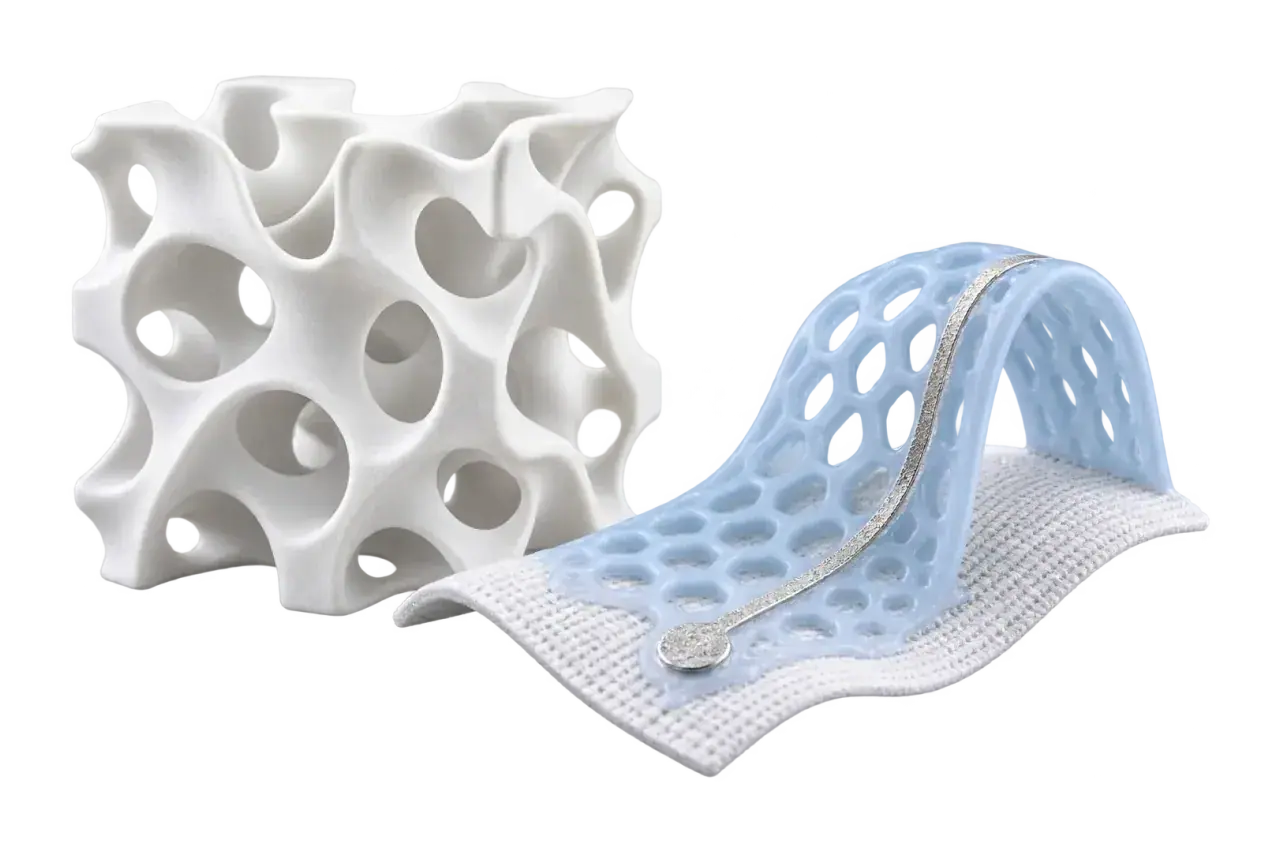
The engagement
A clear scope. A useful outcome.
Move from CAD to a functional prototype, test a design before tooling, or explore printed structures for a new material application. We help select a suitable additive process, develop the geometry and validate samples against your requirements. The service includes printing for smart textiles: flexible structures printed onto fabric, sensor supports and routes for integrating conductive features. Material compatibility, adhesion and electrical behaviour are treated as engineering questions to test, with specialist production partners used where needed.
Capabilities
Functional prototypes and product parts
Enclosures, fixtures, fit-check parts and functional prototypes developed around the intended use. Geometry, tolerances, orientation and finishing are selected together. We define what each sample needs to prove, so the output informs the next engineering decision.
Design for additive manufacturing
Adapt CAD for the chosen process rather than treating printing as a direct substitute for machining or moulding. Wall thickness, supports, assembly features and lattice structures are reviewed against mechanical requirements. You receive the models and the manufacturing considerations behind them.
Printing for smart textiles
Explore flexible polymers printed onto fabrics for wearable structures, sensor mounts and integrated pathways. Conductive inks or filaments can be assessed with appropriate specialist processes. Sample trials establish adhesion, flexibility, resistance and repeatability for the selected textile before a larger build.
Material and sample validation
Compare candidate materials and processes using a test plan tied to the application. For textile-integrated parts, this can include bending, abrasion and wash exposure. The deliverable records the conditions and limitations of the test, with the next development steps clearly stated.
A practical starting point
Start with the question
you need to answer.
Bring an idea, an existing product or a technical constraint. We’ll discuss the scope, dependencies and right first milestone before planning the build.
Contact us ↗Project scope
| Applications | Product prototypes, enclosures, fixtures, wearable and textile-integrated structures |
|---|---|
| Processes | FDM/FFF, resin and specialist additive processes selected to suit the application |
| Smart textiles | Flexible prints on fabric, sensor supports and conductive-feature feasibility |
| Deliverables | CAD models, sample parts, material recommendations and validation findings |
Frequently asked questions
Can you 3D print directly onto fabric?
Selected flexible materials can be printed onto suitable fabrics. Results depend on the textile structure, surface treatment, material and printing conditions. We begin with sample trials to assess adhesion, flexibility and durability before recommending an approach for the product.
Can printed structures be used in smart textiles?
Yes, as an area of product development. Examples include sensor supports, flexible mechanical features and structures that hold conductive elements in place. Printed conductive features require a separate assessment of resistance, strain behaviour and skin-contact requirements. Feasibility is established through measured samples.
Which 3D printing process should we choose?
The choice follows the purpose of the part: visual presentation, fit check, load-bearing use, heat exposure or material evaluation. We compare tolerance, finish, strength, cost and quantity, then select an appropriate process and production route. A printed prototype may use a different process from the final product.
Can a printed prototype be taken into production?
Sometimes additive manufacturing remains the right production method, especially for small batches or complex geometry. Other products benefit from moulding, machining or a hybrid approach. We use prototype results to plan that transition, including changes needed for repeatability, assembly and unit economics.
Let’s make it happen